
TL;DR / Key Takeaways
Front-End Trust Drives Conversion: Shoppers demand absolute transparency during Black Friday and Cyber Monday. One-tap checkouts, visible delivery timelines, and real-time support convert skeptical visitors into buyers.
45-Day Peak Strategy: The smart Q4 approach focuses on optimizing your existing Shopify tech stack to capture peak demand, while using live holiday transaction data to conduct a thorough Back-End Operations Audit ahead of a Q1 backend order and inventory fulfillment overhaul.
Inventory Visibility Protects Margins: Overselling due to sync delays ruins customer trust faster than poor site speed. Automated stock buffers eliminate order cancellations during high-traffic surges.
AI Assisting Execution: Deploying lightweight tools like a Shopify AI shopping assistant handles holiday ticket spikes automatically without adding temporary seasonal headcount.
What is the Peak Season for Retail?
Peak season for retail represents the high-volume fourth-quarter shopping window—anchored by Black Friday and Cyber Monday (BFCM)—where direct-to-consumer and CPG brands generate 30% to 50% of annual revenue. Success requires aligning front-end promotional spikes with real-time stock tracking to prevent costly inventory stockouts.
For Consumer Packaged Goods (CPG) brands, direct-to-consumer (DTC) operators, and food manufacturers running on Shopify, the fourth quarter creates intense operational pressure. Consumer acquisition costs (CAC) spike across paid channels, making every single site visit critical to total annual profitability.
During this window, modern shoppers navigate digital storefronts with heightened skepticism. Because launching an e-commerce storefront requires minimal technical effort, consumers look for immediate signs of legitimacy: transparent shipping costs, social proof, recognizable payment wallets, and instant customer service.
However, optimizing your storefront is only half the battle. When order volume multiplies by 5x or 10x over a 72-hour window, the primary risk shifts from traffic generation to order fulfillment. If your inventory counts lag behind actual warehouse stock, front-end conversion wins turn into post-purchase refund nightmares.
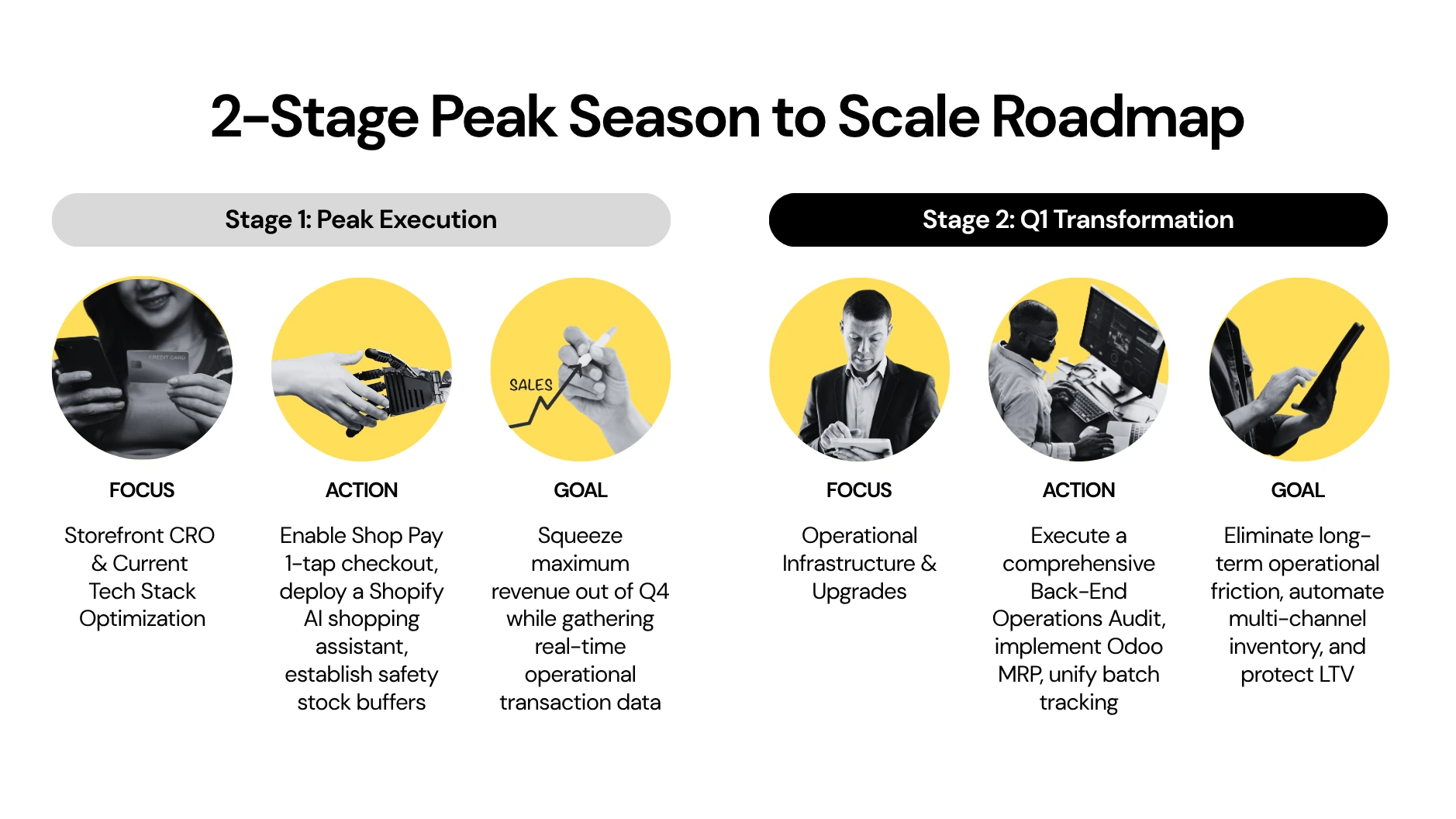
Scaling CPG brands rely on an actionable BFCM 2026 Prep Guide strategy: fine-tuning their current Shopify application layer to squeeze maximum revenue out of Q4, while actively gathering real-time operational metrics during peak sales. This live transaction data feeds directly into a comprehensive Back-End Operations Audit, giving leadership the exact insights required to prepare for a seamless Odoo MRP implementation when sales normalize in Q1.
What Are the Marketing Strategies for BFCM?
Core marketing strategies for BFCM combine high-converting Shopify storefront friction reduction, automated SMS and email cart recovery, transparent delivery promises, and dynamic product bundling. Winning strategies align aggressive front-end traffic capture with real-time inventory availability to fulfill customer expectations without triggering post-purchase cancellations.
Traditional e-commerce marketing strategy focuses heavily on top-of-funnel ad spend, discount structures, and promotional calendars. However, experienced CPG operators recognize that peak-season conversion relies directly on friction reduction across the product detail page (PDP) and checkout sequence.
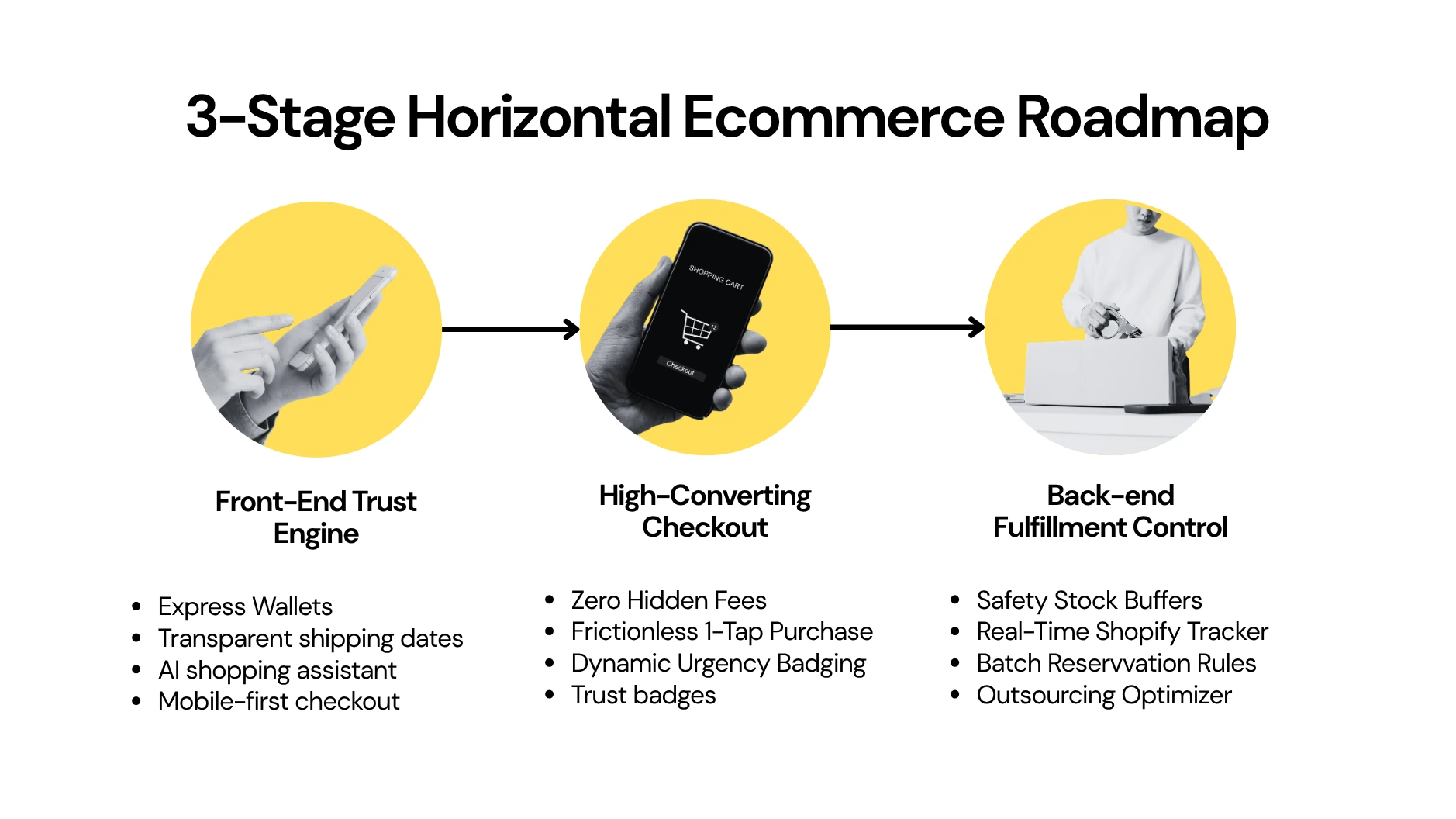
The Three Pillars of Front-End Conversion
Proof of Legitimacy and Security: Modern shoppers look for familiar trust markers before entering payment information. Integrating verified customer reviews, clear return policy badges, and one-click express wallets (Shop Pay, Apple Pay, PayPal) reassures buyers instantly.
Elimination of Hidden Checkout Friction: Surprise shipping fees at checkout remain the primary cause of cart abandonment during holiday promotions. Displaying dynamic shipping calculators or threshold progress bars ("Add $12 for Free Holiday Shipping") directly on the PDP maintains buyer momentum.
Automated Real-Time Support: High traffic increases customer inquiries regarding sizing, ingredients, shipping cutoff dates, and order status. Deploying an integrated Shopify AI shopping assistant answers product questions 24/7, guiding shoppers through checkout without requiring manual support staff.
Operational Metric | Traditional Front-End CRO Focus | Operations-Aligned BFCM Optimization | Business Impact |
PDP Stock Display | Displays binary "In Stock" text. | Displays dynamic real-time inventory thresholds ("Only 14 left"). | Increases urgency while preventing stock over-subscription. |
Checkout Flow | Standard multi-step guest checkout. | Pre-configured express wallets (Shop Pay, Apple Pay). | Cuts checkout friction and boosts mobile conversion rates. |
Holiday Customer Support | Manual email support inbox. | Embedded Shopify AI shopping assistant. | Resolves 70%+ of pre-purchase questions instantly. |
Inventory Allocation | Manual daily spreadsheet updates. | Automated safety stock buffer rules. | Prevents overselling during unexpected traffic surges. |
How to Prepare Your Shopify Website for BFCM?
Preparing your Shopify website for BFCM requires stress-testing mobile page speeds, enabling one-tap checkout wallets, activating automated customer service assistants, and setting safety stock buffers. Front-end promotional speed must integrate seamlessly with inventory allocation rules to maintain site performance and consumer trust during traffic surges.
To execute a flawless peak season, operators must review their digital storefront using a structured Black Friday Checklist 2026. This checklist addresses both front-end user experience and essential back-end data connections.
THE BLACK FRIDAY CHECKLIST 2026 |
1. STOREFRONT SPEED & MOBILE AUDIT
|
2. EXPRESS CHECKOUT & TRUST ARCHITECTURE
|
3. REAL-TIME TRACKING & AI SUPPORT
|
4. INVENTORY SAFETY & BUFFER RULES
|
How to Maximize BFCM Sales on Your Shopify Website
Maximizing BFCM sales on Shopify requires coupling high-converting checkout flows with real-time inventory visibility, dynamic bundle offers, and automated post-purchase shipping tracking. Synchronizing storefront availability with fulfillment workflows eliminates order delays, reduces cart abandonment, and protects profit margins during high-volume peak periods.
Driving high conversion rates during Shopify Cyber Monday and Black Friday demands precise alignment between marketing promotions and inventory availability. A comprehensive Shopify BFCM guide goes beyond simple discount strategies; it establishes strict rules to safeguard gross margins and preserve customer lifetime value.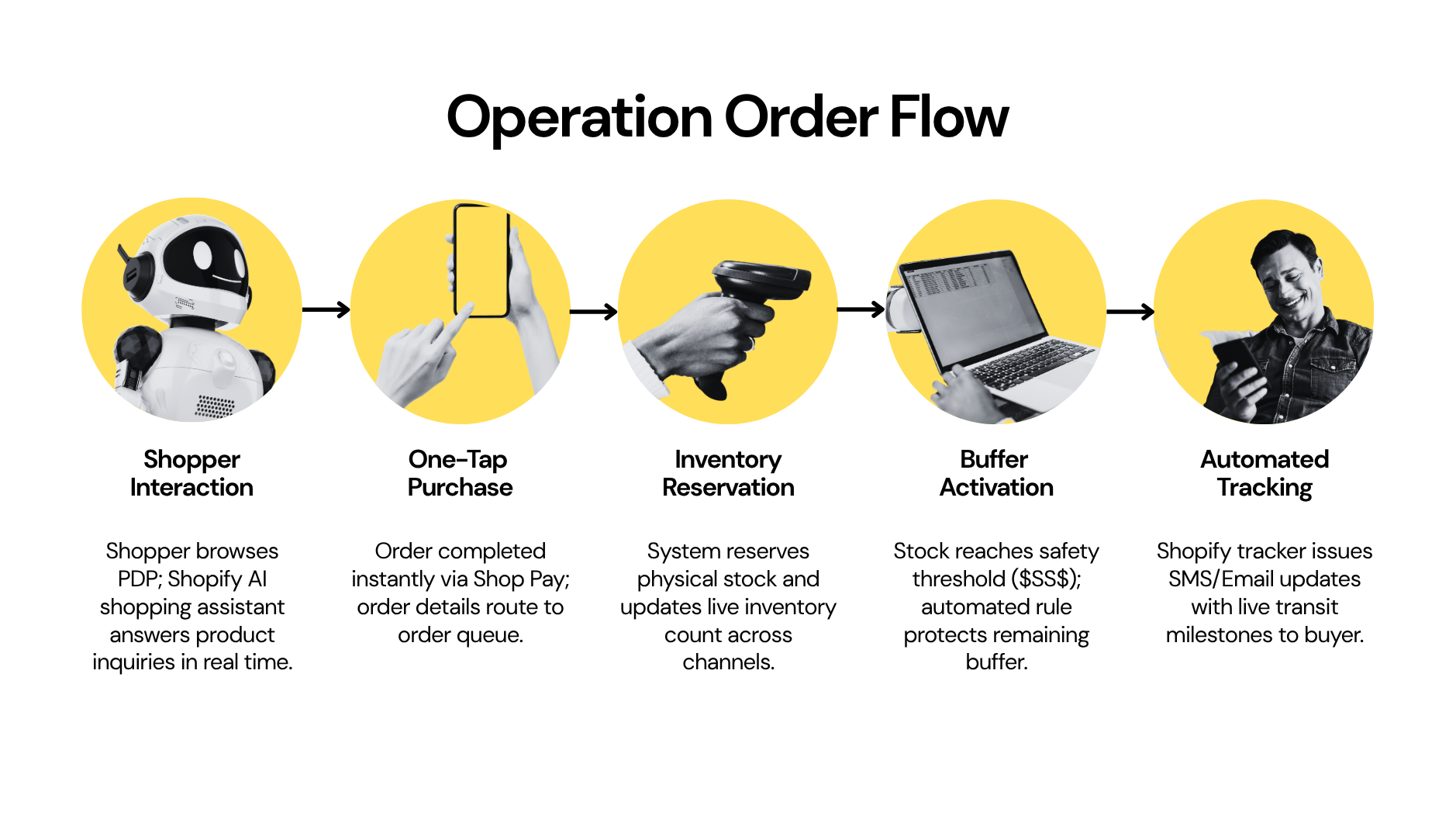
Practical Peak Buffer Strategy (No Complex Formulas Required)
Instead of over-complicating holiday prep with theoretical statistical formulas, scaling CPG operators rely on three practical rules of thumb to set safety inventory buffers inside Shopify:
The Peak Demand Multiplier (3x–5x Rule): Multiply your average daily sales for core SKUs over the last 30 days by your projected holiday traffic surge. If you sell 50 units a day normally and project a 4x surge during Cyber Week, your baseline target for the 4-day weekend is 800 units.
The 15% System Sync Buffer Floor: Web traffic moves faster than API inventory updates between Shopify, 3PL warehouses, and software during peak hours. Set an automated rule in Shopify to auto-hide or trigger a "Low Stock" notification when available inventory hits 15% of total stock. This buffer absorbs delayed order processing without double-booking items.
The Carrier Backlog Pad (+5 Days): Freight and parcel carriers face severe backlogs in November. Add 5 extra buffer days to your standard supplier lead times to ensure raw ingredients and finished goods reach the fulfillment center well before your promotional campaigns go live.
Bridging Q4 Promotional Execution with Q1 Back-End Scale
Squeezing maximum sales out of your existing tech stack during Q4 establishes immediate revenue momentum. However, as transaction volumes scale, peak holiday stresses inevitably expose operational bottlenecks: manual inventory adjustments, inaccurate landed COGS calculations, lot-tracking vulnerabilities, and channel sync delays.
Conducting a Shopify BFCM optimization review after holiday fulfillment concludes provides clear data on where your tech stack held up—and where it cracked under pressure.
When retail activity normalizes in Q1, CPG operators transition from temporary front-end fixes to permanent operational infrastructure: executing a formal Back-End Operations Audit and implementing an integrated Odoo MRP and ERP system. This long-term operational foundation automates batch tracking, unifies multichannel sales, and protects profit margins across every sales surge to come.
Great stories have a personality. Consider telling a great story that provides personality. Writing a story with personality for potential clients will assist with making a relationship connection. This shows up in small quirks like word choices or phrases. Write from your point of view, not from someone else's experience.
Great stories are for everyone even when only written for just one person. If you try to write with a wide, general audience in mind, your story will sound fake and lack emotion. No one will be interested. Write for one person. If it’s genuine for the one, it’s genuine for the rest.