
Black Friday and Cyber Monday can create a large sales spike. They can also expose every weak point in your business.
Inventory runs out. Orders sit in disconnected apps. Customers receive the wrong shipping updates. Paid media costs rise while your team works late to fix problems that should have been automated.
For a lean team, the answer is not more tools. It is a complete circuit from acquisition to fulfillment.
This guide explains how to build a profitable Black Friday ecommerce plan, protect your margin, and keep your operations moving through the full 55-day holiday window.
TL;DR: Key Takeaways
- Acquire customers before November: Meta CPMs can rise 30%–60% in early November and increased 28.4% month over month during Cyber Week.
- Prioritize returning customers: Returning shoppers generated 19.5% YoY GMV growth, compared with 13.4% for new buyers. Repeat purchases account for more than 56% of holiday order volume.
- Do not rely on discounts alone: Only 4% of customers acquired through standard Black Friday discounts purchased again within 12 months.
- Use video-first creative: Short-form video under 15 seconds can lift conversions by 20%–40% compared with static banners.
- Segment your email list: Segmented campaigns drive nearly 80% of holiday email revenue, while loyalty and referral workflows can reach a 25.1% CTR.
- Forecast from your active file: BFCM Forecast = 6-Month Active Buyers × 6.6%.
- Freeze major technology changes by November 1: Your order and inventory management system must be tested before peak traffic arrives.
The Real Black Friday Problem: One Sales Event, Many Failure Points
Black Friday online shopping is not one moment. It is a chain of connected events:
- A customer sees an ad.
- They visit your website.
- They browse a product or offer.
- They enter your email or SMS list.
- They place an order.
- Inventory updates.
- The warehouse receives the task.
- The customer receives tracking.
- Your team handles returns, exchanges, and follow-up.
If any link breaks, the customer feels it.
A strong Black Friday online shopping strategy does more than increase traffic. It makes every handoff reliable. Your marketing, storefront, inventory, warehouse, finance, and customer service systems should behave like one engine.
1. September and October Are Your Acquisition Window
Waiting until November to acquire new customers is expensive.
According to Opensend’s ecommerce CPM benchmarks, Cyber Monday Meta CPM reached $17.70 in one benchmark period: 138% above the annual average. Other data shows Meta CPMs rising 30%–60% in early November, with a 28.4% month-over-month increase during Cyber Week. A Reddit Meta advertising discussion also reflects the seasonal pressure advertisers see in November.
The math is simple:
- At a $10 CPM, a $10,000 budget buys 1 million impressions.
- At a $16 CPM, the same budget buys 625,000 impressions.
- That is roughly 37% less reach per dollar.
Use September and October to build your active customer file before the auction becomes crowded.
Actions for September and October
- Run Labor Day and back-to-school acquisition campaigns.
- Test new audiences and creative angles before peak season.
- Launch win-back flows for customers who have not purchased recently.
- Build lookalike audiences from high-value customers.
- Capture email and SMS subscribers with useful offers, not only discounts.
- Move proven customers into VIP and loyalty segments.
2. Returning Customers Are the Core Q4 Revenue Engine
New customers matter, but returning shoppers often produce stronger holiday economics.
Loop’s BFCM data found that returning shoppers generated 19.5% YoY GMV growth, compared with 13.4% for new shoppers. Data from Drip’s Black Friday benchmarks shows that repeat purchases account for more than 56% of holiday order volume.
This is one of the most important Black Friday online shopping statistics for a lean team: your existing customer base is not a side audience. It is the foundation of your Q4 forecast.
The risk is acquiring customers who never return.
The DEPT Peak Season Retail Report found that only 4% of single-purchase buyers acquired through standard Black Friday discounts bought again within 12 months. A discount may create a transaction without creating a relationship.
Build offers around customer value
- Give VIP customers early access.
- Use bundles to increase average order value.
- Create product education campaigns after purchase.
- Recommend complementary products based on the first order.
- Use loyalty and referral campaigns instead of sending the same discount to everyone.
- Offer exchanges or store credit where it makes operational and financial sense.
3. Avoid the Four Q4 Traps
Trap 1: A month-long sitewide sale
A sale that runs for all of November teaches customers to wait. It also compresses your margin for weeks.
Trap 2: Static “20% off” graphics
Creative quality accounts for roughly 70% of performance variance on Meta, according to Web Tonic’s ecommerce creative benchmarks.
Your ad should explain why the product matters. It should not look like a price tag pasted onto a blank image.
Trap 3: Offer stagnation
The same offer shown for weeks creates fatigue. Refresh the product focus, message, audience, or offer structure.
Trap 4: Selling the same way on every channel
Paid and organic social should earn attention through demonstrations, useful content, customer stories, and entertainment. Email, SMS, and Stories are better places for direct selling and urgency.
Short-form video under 15 seconds can deliver a 20%–40% conversion lift over static banners. Use product demonstrations, customer reactions, unboxings, and simple face-to-camera explanations.
4. Use a 55-Day Promotional Rolodex
Do not run one giant promotion. Stagger the calendar from November 1 through December 25.
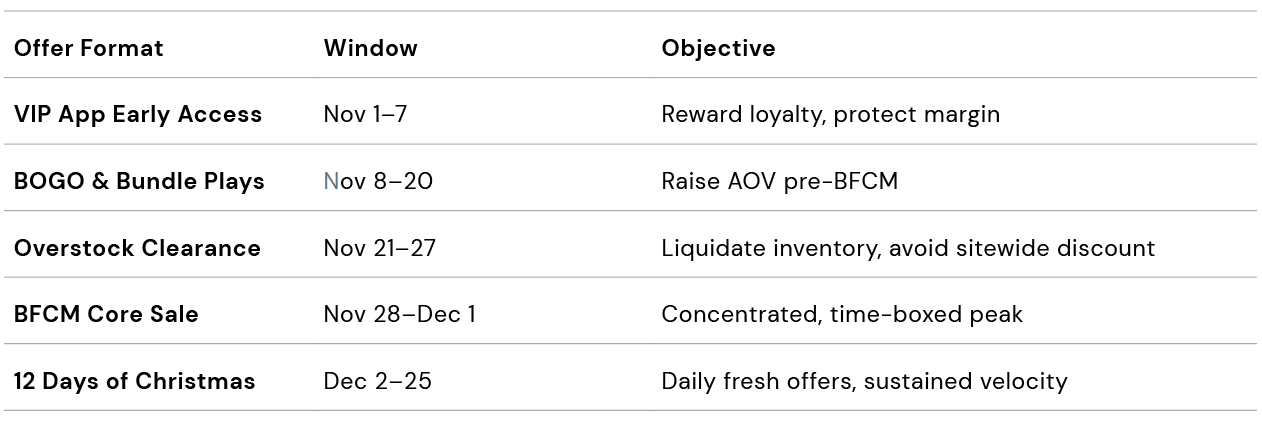
This structure gives customers more than one reason to buy while giving your team more than one way to manage inventory.
Segment the calendar by customer behavior:
- VIP and repeat buyers receive early access.
- New subscribers receive product education and a first-purchase offer.
- Discount-sensitive buyers receive controlled clearance offers.
- High-AOV customers receive bundles and premium products.
- Lapsed customers receive win-back messages.
Drip’s research reports that segmented campaigns drive nearly 80% of holiday email revenue, even though only about 20% of merchants use segmentation consistently. Loyalty and referral workflows can generate CTRs as high as 25.1% during Cyber Week.
5. Build a Conversion-Ready Storefront
Your black friday website design does not need to be complicated. It needs to be clear, fast, and trustworthy.
Create a dedicated Black Friday landing page with:
- The main offer and expiration date.
- Featured products and bundles.
- Shipping deadlines.
- Return and exchange rules.
- Clear inventory messaging.
- Reviews and trust signals.
- A simple mobile checkout path.
- A free-shipping threshold or progress bar.
Test the full path before launch:
- Mobile and desktop checkout.
- Discount codes.
- Product variants.
- Inventory deductions.
- Payment confirmation.
- Customer emails.
- Tracking numbers.
- Analytics and ad events.
These are practical Black Friday ecommerce tips, but they are also system tests. A beautiful page cannot repair a broken order flow.
6. Connect Shopify, Marketplaces, and Fulfillment
Many lean brands use Shopify as their primary storefront. That works until orders, stock, shipping, and finance live in separate systems.
Your Shopify Black Friday strategies should include a shared source of truth for:
- Shopify orders.
- Amazon and other marketplace orders.
- Warehouse stock.
- Purchase orders.
- Shipping status.
- Invoices.
- Returns.
- Customer records.
An order and inventory management system should update stock across every sales channel when an item sells. It should also send the correct fulfillment task to the warehouse without manual re-entry.
That is the difference between adding more software and building a complete operational circuit.
7. Use the BFCM Revenue Predictor
You do not need complex data science to set a first revenue target.
Use this formula:
> Forecast = 6-Month Active Buyers × 6.6%
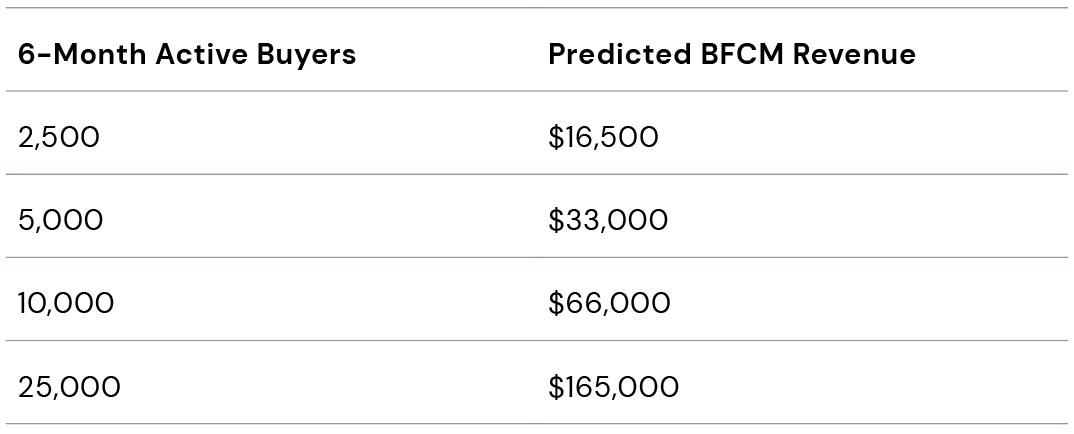 This is a planning benchmark, not a guarantee. Compare it with your historical conversion rate, average order value, margin, inventory, and channel mix.
Start by auditing your active customer file. If the number is smaller than expected, you still have time to improve it through acquisition, win-back, and subscriber campaigns.
8. Set Ops and Finance Guardrails
Revenue is not the same as profit. A successful promotion can still damage the business if fulfillment costs, returns, labor, and discounts consume the contribution margin.
Use three guardrails.
Margin over top-line revenue
Every offer should pass a margin test after:
- Product cost.
- Discount.
- Payment processing.
- Shipping subsidy.
- Advertising cost.
- Expected returns.
- Labor and fulfillment costs.
Ask, “What breaks if we win?”
Stress-test:
- Warehouse capacity.
- Pick-and-pack time.
- Customer support volume.
- Shipping supplies.
- Cash needed for replenishment.
- Best-selling SKU availability.
- Return and exchange processing.
Freeze technology changes by November 1
Do not launch a new ERP, 3PL, Shopify app, or major backend workflow after November 1.
Finalize site and backend changes by October 15. Test every order path before the freeze. Peak season is not the time to discover that two systems use different SKU names.

9. Assign Owners and Deadlines
A five-person team cannot afford unclear ownership.
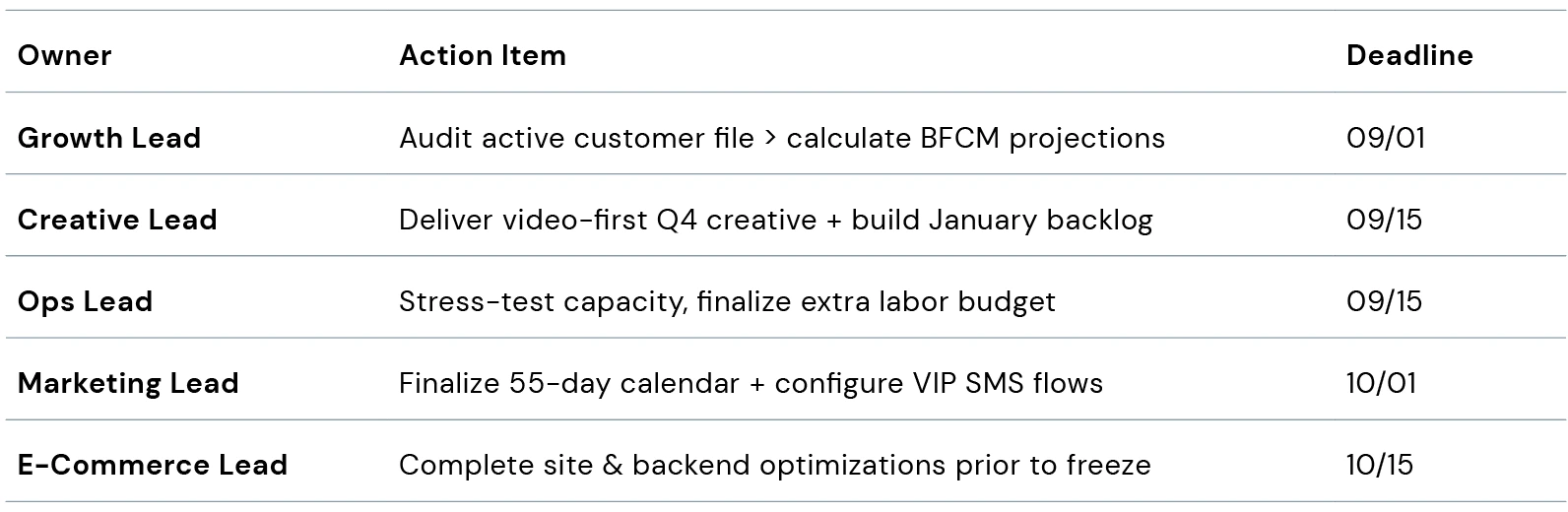
Two urgent follow-ups should happen immediately:
- Within 24 hours: Complete the active customer file audit.
- Within 48 hours: Review fulfillment capacity, inventory accuracy, shipping timelines, and exception handling.
Make Your Holiday Window a Complete Circuit
Black Friday ecommerce growth is not just a marketing problem. It is a systems problem.
Traffic, creative, email, storefronts, inventory, orders, fulfillment, billing, and customer service must move together. When they do, a lean team can handle more volume without adding layers of manual work.
When they do not, every disconnected handoff becomes a black hole where margin and productivity disappear.
OneVector helps growing brands connect their storefronts, order flows, inventory, warehouse operations, and automation into one centralized operating engine. We can also help identify repetitive work that an AI employee or automation workflow can handle, including follow-ups, customer communication, scheduling, and operational updates.
Request a complimentary Q4 e-commerce infrastructure assessment to prepare your order and inventory management system for the 55-day holiday window.
Sources
- Opensend : Cost Per Impression Statistics for Ecommerce
- Meta advertising discussion on Reddit
- Loop Returns : Black Friday and Cyber Monday Data Insights
- Drip : Black Friday Statistics
- Web Tonic : E-commerce Ad Creative Statistics
- DEPT, Peak Season Retail Report : cited in the webinar summary supporting the 4% repeat-purchase benchmark.
This article is an independent strategic analysis based on the cited benchmark sources and a webinar summary. Brand names, trademarks, and third-party references belong to their respective owners and do not imply sponsorship or endorsement by OneVector LLC.